

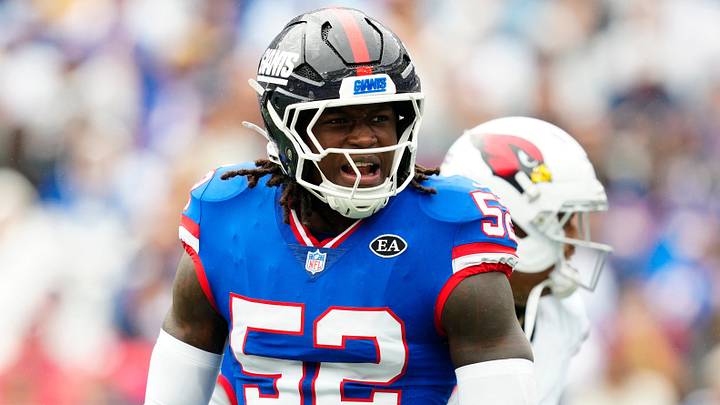
New York Giants linebacker Arvell Reese reminds me so much of myself. Okay, maybe just his cool last name; that's about where the comparison ends.
Reese continues to strengthen his Defensive Rookie of the Year case and is currently favored over New York Jets defensive end David Bailey. Bailey was the No. 2 overall selection, so the Arizona Cardinals didn't have that option. But why in the world did this team pass up on Reese?
Cardinals' decision to pass up on Arvell Reese looks worse than ever
The Ohio State product somehow managed to fall to the Giants at No. 5, with the Cardinals prioritizing offense yet again with their decision to draft Notre Dame running back Jeremiyah Love No. 3 overall instead.
Love still has plenty of time to pan out but is off to an underwhelming rookie campaign largely due to injury. He's currently on the IR with a high ankle sprain, serving as a reminder of the risk the Cardinals took on when they invested such a high pick at the running back position in general.
Not only is it such an injury-prone position, but it's also relatively replaceable. Teams are typically picking in the top five for a reason and have more important roster holes to address. That also applied to the three-win Cardinals; however, GM Monti Ossenfort continues to prioritize the skill positions like running back and wide receiver rather than actually addressing the root of these roster problems.
Arizona now faces a dilemma ahead of Tuesday's trade deadline, as their top trade candidates lie on the defensive side of the ball. However, this team is also surrendering an average of 28.3 points per game, second most in the league, only behind the Las Vegas Raiders. Ossenfort may feel the need to keep whatever established pieces they do have left to hold this thing together.
Had he drafted Reese, it would've been huge in terms of having that foundational defensive piece who is young enough to align with this rebuilding timeline. Right now, the leader on that side of the ball for Arizona is franchise icon and safety Budda Baker, though he's no longer an ideal fit at 30.
Passing up on a future defensive building block in Reese just to draft a running back was already a questionable decision in the first place. But seeing the two now on opposite rookie trajectories at midseason makes Ossenfort's decision look even worse in retrospect.
Again, Love has plenty of time to right the ship. But it seems like a multi-year project for the Cardinals to build the offensive infrastructure he needs to really shine. That's not ideal for a running back's window. It's also not ideal when you consider how important defense is compared to running back when building a contender.
Love is talented enough that this pick may turn out fine in the scheme of things. But in a vacuum, Ossenfort passing on Reese to take Love sums up what's wrong with his backward approach to building this roster. The Cardinals keep prioritizing these skill-position players and then can't even put them in the right spots to succeed, leaving other, more important holes unaddressed.
Reese wouldn't have filled all those holes on defense, but he certainly would've gotten this rebuild trending in the right direction with him to build around. Most importantly, it would signal a shift in Ossenfort's approach. Until that happens, or unless the Cardinals move on from him entirely, they could be stuck in this endless rebuilding cycle, trying to put the finishing touches on a house that never has a strong enough structure.
 Add us as a preferred source on Google