

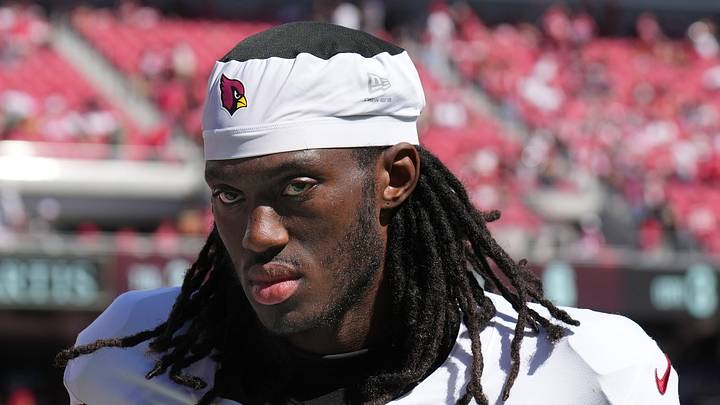
Marvin Harrison Jr. played just 12 snaps in his debut with the Houston Texans. In just that limited action alone, the Texans already managed to make as much, if not more, of an offensive priority than the Cardinals.
The former No. 4 overall pick finished with three receptions for 34 yards. Believe it or not, those receptions tied a season high for Harrison, dating back to Week 3, when he went for 40 yards.
That's incredibly telling about how much Harrison has struggled to produce in Arizona. And it's only a matter of time before DeMeco Ryans and the Texans ramp up his opportunities as he gains more familiarity with the offense.
Maybe Marvin Harrison Jr. wasn't the problem in Arizona
On the one hand, it was surprising the Cardinals were able to turn Harrison into a second-round pick from the Texans, seeing how much of an afterthought he was in Arizona's offense.
On the other hand, it's a rare opportunity for Houston to take a flyer on a 24-year-old who is just years removed from being a top five pick.
Unfortunately, the Cardinals have a history of failing to maximize talent. If I'm a general manager around the league, I'm looking at messy situations like Arizona to see if we can find untapped potential that's being underutilized.
That's what Houston hopes to find in Harrison, who already appears to be benefiting from a change of scenery and particularly a reunion with former Ohio State teammate C.J. Stroud.
Stroud has vouched for Harrison's work ethic, meaning this trade has the potential to age poorly should he ultimately reach that starting ceiling in Houston. At the time, it was good value for Arizona to come away with a second-round pick for someone who seemingly lost the trust of quarterback Jacoby Brissett.
But should Houston prove that Harrison wasn't truly the problem, it's only going to make this trade look that much worse for the Cardinals -- and their organization looks that much more incompetent due to their inability to make both the Kyler Murray pick and now the Harrison pick work.
Harrison clearly still has that talent and skill set Arizona saw in him when they decided to pick him over the likes of Malik Nabers and others. A receiver's connection, or lack thereof, with his quarterback goes a long way in that production.
That's why former GM Cardinals Steve Keim has even criticized the decision to trade Harrison, calling it an "awful decision." Keim added that he would've first seen whether a swap to Carson Beck at quarterback would've done better in terms of unlocking Harrison's potential.
Texans will unlock Marvin Harrison Jr. better than Cardinals ever could
Trading away a struggling Harrison is one thing if you genuinely made an effort to get him involved and prioritize him in the offense. He totaled just 12 targets through the first four games before the Cardinals decided they'd seen enough, willing to move on from their steep draft investment just three years into his young career.
Not only that, but we've already seen through two games without Harrison that the Cardinals needed him more than his stats suggested. Harrison did an underappreciated job of drawing attention off of Michael Wilson, who has struggled to emerge as that genuine WR1 for the Cardinals in his absence.
Arizona in all likelihood will still turn to Beck at some point later in the season. But now it's going to be that much more difficult to succeed as a third-round rookie in that expected audition, seeing as the Cardinals suddenly have a weak wide receiver room.
Beyond Beck, that's also problematic should the Cardinals select a quarterback in this first-round pick of the 2027 NFL Draft. They do still have offensive weapons like tight end Trey McBride and running back Jeremiyah Love, but whatever young quarterback Arizona does eventually throw out there won't be benefiting from what at one point was a perceived strength of this roster.
Pair that shaky group of pass catchers with what remains a below-average offensive line, and this Harrison trade may have been a mistake.
The Cardinals turned Harrison and a 2027 sixth-round pick into a 2027 second-round pick and a seventh-rounder. With that added draft capital, they can use it to address these roster holes. However, that pick looks increasingly less valuable with Stroud and the Texans playing much better than their record suggests.
And it's only a matter of time before Harrison further contributes to that winning.
His positive impact already impressively stood out in just 12 snaps, suggesting Harrison should be made far more of a priority in Houston than he was in Arizona. If that trend continues, the Cardinals will have unnecessarily moved on from a No. 4 overall pick when they still need help at the position.
That's how this trade ultimately backfires for the Cardinals. The way they mishandled Harrison by failing to prioritize him in the offense was already a massive setback in this rebuild. If Harrison is able to produce in Houston, it's further proof he was never truly the problem in Arizona.
They'll should reevaluate everything from top to bottom of this organization at that point. That's becoming an increasingly likely scenario, seeing how much Harrison was involved during his brief Texans debut.
 Add us as a preferred source on Google